
Fine Ribbed Rubber Flooring — Anti-Slip Ribbed Matting for Walkways, Gyms and Workshops
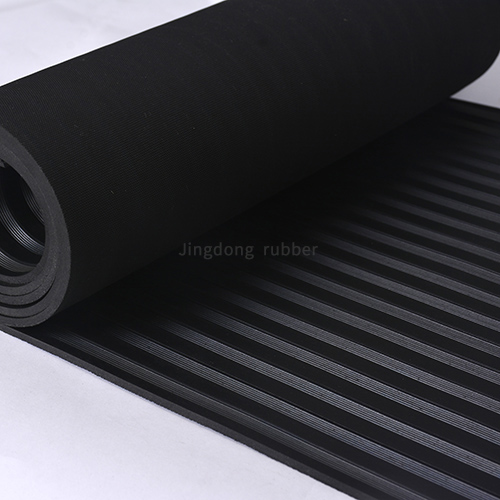
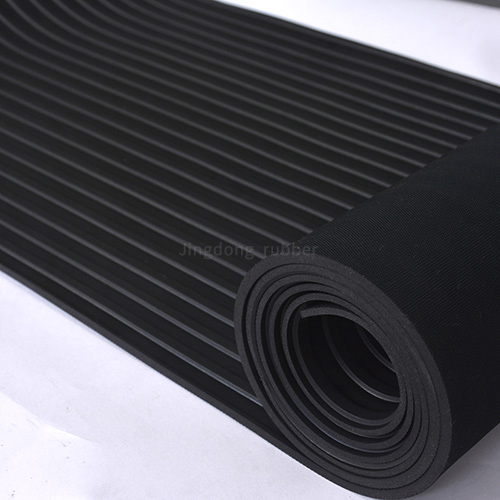
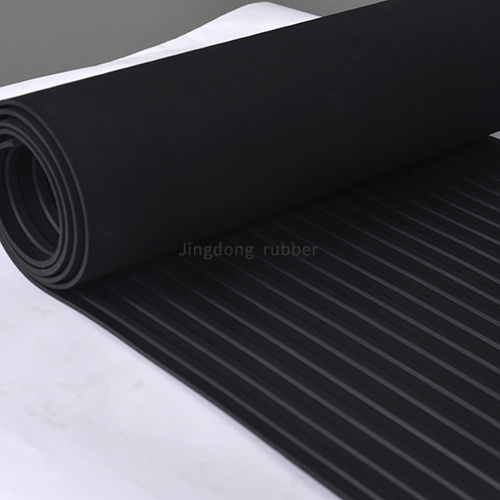
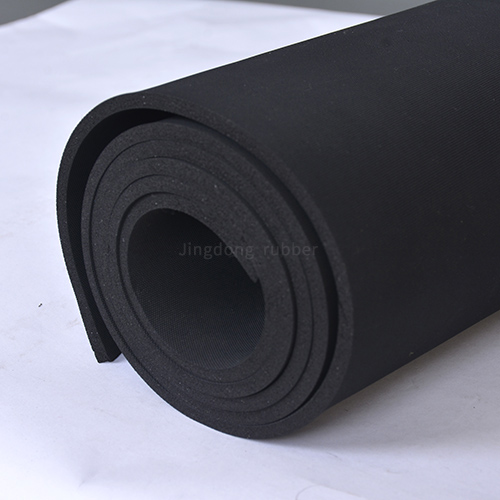
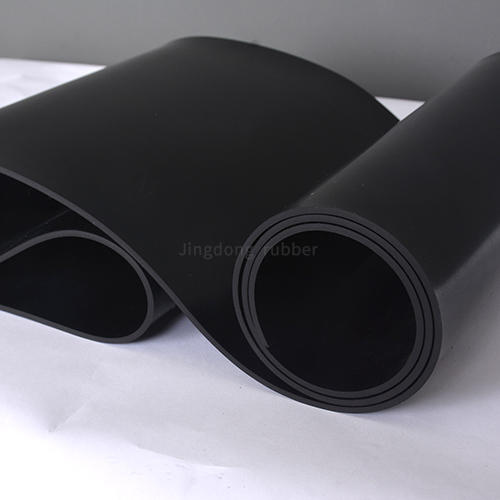
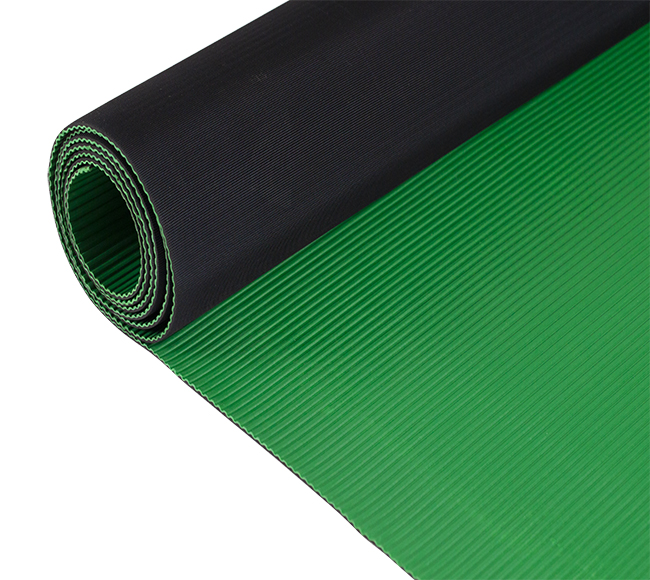
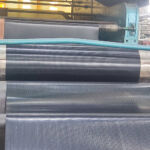
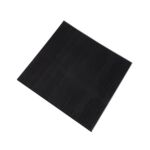
A ribbed rubber flooring in an NR/SBR blend of natural rubber and styrene butadiene rubber, with a fine rib pattern on the face and a cloth-impression backing. Supplied from 3 mm to 10 mm thick and 0.915 m to 2 m wide, in black, grey or green, and cut to length. The rib pattern is the reason for the product rather than a decorative detail: the ribs give grip across the roll and channel water away so the surface does not hold a film of liquid. Fabric insertion is available where the mat must not stretch under load.
Fine Ribbed Rubber Flooring — Anti-Slip Ribbed Matting for Walkways, Gyms, Workshops and Loading Areas
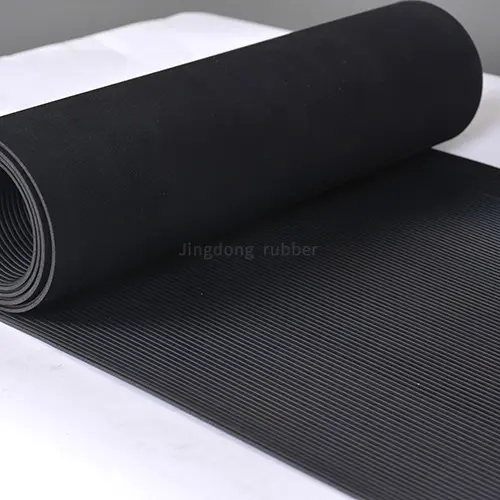
Fine ribbed rubber flooring is a rubber mat supplied in roll or cut-sheet form with a pattern of narrow, closely spaced ribs running the length of the roll. The face profile does two jobs at once. The rib edges give grip underfoot in the direction across the roll, and the channels between the ribs give water, oil and general spillage somewhere to go instead of sitting as a film on top of the surface. A smooth rubber mat becomes slippery as soon as it is wet; a ribbed one does not, which is why this profile is used wherever people walk with wet or contaminated footwear.
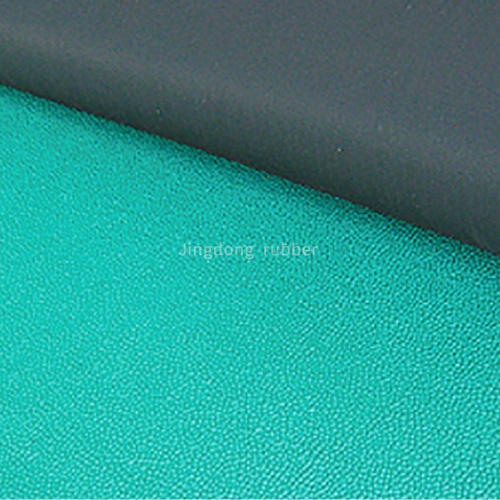
The reverse face carries a cloth impression. This is a weave texture transferred during curing, and it is not cosmetic: it gives the underside a key that grips a subfloor and holds adhesive, so an installed mat does not creep or lift at the edges. Where the mat has to span a gap, be laid over a soft substrate, or carry trolley traffic without stretching, a fabric-inserted version is available. Fabric insertion embeds a woven layer inside the rubber, and its effect is to control stretch in both directions — the single most useful option on this product for anyone laying a large continuous area.
The compound is an NR/SBR blend. Natural rubber contributes tensile strength, tear resistance and resilience, and resilience is what makes a rubber floor comfortable to stand on for long periods. SBR contributes abrasion resistance at a lower cost than natural rubber alone, which is why the blend is the standard compound for general-purpose rubber flooring rather than either polymer on its own. The 3 MPa tensile strength and 200 % elongation in the table below are typical of a flooring compound: flooring is specified on wear and grip rather than on high tensile figures, and those two properties are what the compound is formulated for.
What the blend does not give is weather resistance. NR and SBR both have unsaturated main chains, so ozone and ultraviolet light can attack them, and a mat left permanently outdoors will harden and crack. That limitation is set out in full below, because it determines which of the applications on this page the product is actually suitable for. Where outdoor exposure is unavoidable, EPDM rubber sheet is the correct material and is covered separately.
Physical Properties and Colour Options
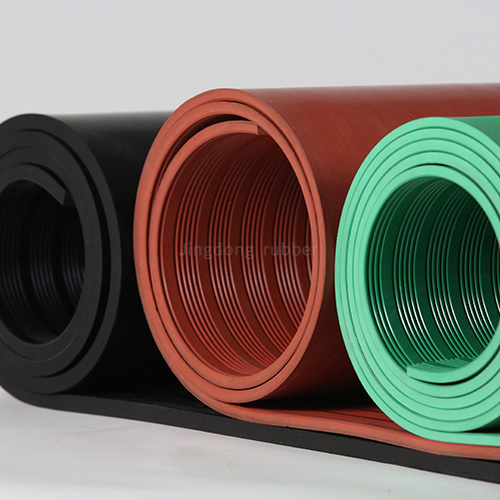
This profile is produced in three colours. All three use the same NR/SBR compound and the same mechanical properties; they differ only in colour and in specific gravity, because a colour other than black cannot use carbon black as the filler and reinforcement. The coloured grades therefore carry a higher proportion of mineral filler, which is why grey and green come out denser than black at 1.6 g/cm³ against 1.5 g/cm³.
Physical properties — on a mobile device, scroll sideways to read every column.
| Colour | Material | S.G. g/cm³ | Hardness Shore A | Tensile strength MPa | Elongation at break % |
|---|---|---|---|---|---|
| Black | NR/SBR | 1.5 | 65 ± 5 | 3 | 200 |
| Grey | NR/SBR | 1.6 | 65 ± 5 | 3 | 200 |
| Green | NR/SBR | 1.6 | 65 ± 5 | 3 | 200 |
Two corrections to the existing table. First, the source data sheet writes the hardness tolerance as 65+5 with the plus sign underlined, which renders as “65+5” and reads as sixty-five plus five. Hardness tolerance is written with a plus-minus symbol, so it should be 65 ± 5 Shore A, as corrected above. Second, the source table has a CODE column in the header with all three cells left empty, and a SPECIFICATION column that repeats NR/SBR on all three rows. There is no grade structure on this product — there are three colours of the same compound — so the SPECIFICATION column has been relabelled Material and the empty CODE column removed. If genuine compound codes do exist for this profile, they should be added back, because buyers quote codes when reordering.
Test methods to add: tensile strength and elongation should be reported against ASTM D412, hardness against ASTM D2240 and specific gravity against ASTM D792. Three figures that a flooring buyer will ask for and that the data sheet does not currently carry are the slip resistance rating (DIN 51130 ramp test giving an R value, or a pendulum test to BS 7976 / ASTM E303), the fire classification to EN 13501-1, and the rebound resilience as a percentage, which is the measurable basis for the anti-fatigue claim. Supplying those three turns this page from a general description into a specification a contractor can submit.
Standard Dimensions and Supply Form
The profile is supplied in roll form and cut to length. Thickness, width and length are quoted as ranges rather than single sizes, and the exact figures for a given order are confirmed at quotation.
- PatternFine rib, top face; cloth impression, reverse
- MaterialNR/SBR blend
- Thickness3 mm up to 10 mm
- Width0.915 m up to 2 m
- Length10 m to 20 m
- ColourBlack, grey or green
- Fabric insertionAvailable on request
- Cut sizesCut to length or to drawing
- Thickness toleranceTo be confirmed
- Roll weightTo be confirmed per thickness
- Service temperatureTo be confirmed
Three values to add. Thickness tolerance matters because a 3 mm mat has to sit flat and a +/- 0.5 mm variation will show at the seams of a continuous floor. Roll weight matters because it determines what a two-person team can handle on site and whether a roll needs mechanical lifting. Service temperature matters because NR/SBR compounds are typically usable from roughly −20°C to +70°C, and stating a figure rather than leaving it blank is what stops a buyer assuming the wide range that EPDM or silicone would offer. If the fabric-inserted version has a different thickness or width range from the plain version, that should be shown as a separate line.
Where Fine Ribbed Rubber Flooring Is and Is Not Suitable
This is the section that prevents a wrong order, and it is the section most flooring pages omit. The compound is an NR/SBR blend, which is a high-wear, high-grip material and a poor weather and oil material. The two properties do not travel together, and the applications where each matters are different.
Suitability — on a mobile device, scroll sideways to read every row.
| Situation | Suitable | Reason |
|---|---|---|
| Indoor walkways, corridors and stairs | Yes | The ribbed face gives grip underfoot and the material wears well under foot traffic. The natural rubber content gives the resilience that makes a floor comfortable to stand on. |
| Gyms, fitness areas and sports floors | Yes | Impact absorption and grip under free weights and equipment. The material is resilient rather than hard, and the rib profile drains sweat and spilled water. |
| Workshops and production areas | Yes, with a qualification | Suitable where the floor stays dry. Not suitable where machine oil, hydraulic fluid, diesel or solvent is regularly spilled, because NR and SBR both swell in petroleum-based liquids. |
| Commercial kitchens and wash-down areas | Yes, with a qualification | Water, food spillage and grease from food are handled well and the ribs channel liquid away. Petroleum-based oils and cleaning solvents are not. |
| Loading bays, ramps and doorways open to weather | Only if covered | Suitable under a canopy or inside a door line where rain does not sit on the surface. Permanently exposed to sun and rain, the compound hardens and cracks because NR and SBR have unsaturated main chains that ozone and ultraviolet light attack. |
| Permanently outdoor areas | Not recommended | Use EPDM rubber sheet or an EPDM-based mat instead. EPDM has a saturated main chain and does not suffer the ozone and UV cracking that NR/SBR does. |
| Areas with regular oil or fuel spillage | Not recommended | NR and SBR have poor resistance to petroleum oils and fuels. Use an NBR-based mat instead. |
| Animal stables and wet livestock areas | Use a purpose-made mat | Covered by the stable mat range, which is formulated and profiled for that duty and for the cleaning chemicals involved. |
Where a project calls for outdoor use, oil resistance, or a documented fire classification, say so at enquiry. The same profile can be produced in a different compound where the volume justifies it, and it is far cheaper to specify the right compound at the start than to replace a floor after a season.
Applications
Fine ribbed rubber flooring is used wherever a hard floor needs grip, comfort underfoot and a surface that sheds water rather than holding it.
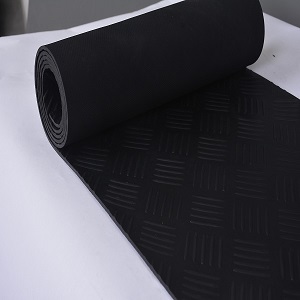
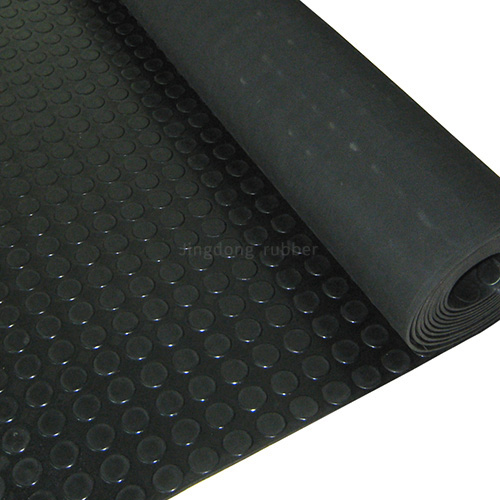
The same anti-slip family covers several different face profiles, and the profile is usually chosen to match the traffic rather than the duty. Checker rubber flooring gives a studded grip for heavier industrial traffic, flat ribbed rubber flooring gives a lower-profile surface where trolleys run, and wide ribbed rubber flooring opens the channels for higher water flow. All of them are listed under the anti-slip rubber flooring category, and the application notes by industry are collected on the applications page.
Installation, Cutting and Maintenance
Rubber flooring performance in service depends as much on how it is laid as on the compound. The steps below cover the points that determine whether an installed floor stays flat and stays put.
Installation guidance — on a mobile device, scroll sideways to read every row.
| Step | What to do | Why it matters |
|---|---|---|
| Let the roll relax | Unroll the matting and leave it flat at room temperature for at least 24 hours before laying or cutting. | Rubber takes a set from being rolled. Cutting and bonding a sheet that is still curled produces lifted edges that no amount of adhesive will hold down. |
| Prepare the subfloor | The subfloor must be dry, clean, sound and flat. Fill and level any hollows before laying; the tolerance depends on the mat thickness. | The cloth-impression backing is what keys the mat to the floor. Dust, loose screed or moisture stops it bonding, and any hollow shows as a soft spot that flexes under traffic. |
| Acclimatise before bonding | Bring the matting to the temperature of the finished space before installation, and lay it out to check the fit and the direction of the ribs. | Rubber expands and contracts with temperature. A mat cut in a cold store and laid in a warm room will grow and buckle. Check the rib direction too, because ribs are normally run across the direction of travel. |
| Cutting | Cut with a sharp knife against a straight edge, or with a die for repeated parts. Cut from the backing side where a clean edge matters. | A blunt blade tears the rib profile rather than cutting it, which leaves a ragged edge and a visible seam. |
| Bonding | Use a contact adhesive recommended for NR/SBR rubber. Apply to both surfaces, allow it to become tacky, then lay and roll the mat to expel trapped air. | Rubber flooring adhesives are not interchangeable. An adhesive specified for vinyl or for EPDM will not develop the same bond on an NR/SBR compound. |
| Seams | Butt seams tightly and roll them, or cut a shallow groove and bond a cover strip where a continuous floor is required. | Open seams let water under the mat, and water trapped under rubber flooring causes mould growth and lifting that is difficult to reverse. |
| Cleaning | Sweep or vacuum, then damp mop with a neutral detergent. Rinse and dry. | Solvent-based cleaners and aggressive degreasers attack the compound. Most damage to rubber flooring is done by the cleaning regime rather than by traffic. |
| Inspection | Check edges, seams and any area subject to trolley traffic at regular intervals, and re-bond lifted edges early. | A lifted edge catches trolley wheels and is torn off quickly. Re-bonding it while it is small is a five-minute job; after a season it is a replacement. |
Buyer FAQ
- What is fine ribbed rubber flooring and what makes it anti-slip?The mat has a pattern of narrow, closely spaced ribs running the length of the roll. The rib edges give grip underfoot across the direction of the roll, and the channels between the ribs let water and general spillage drain away instead of sitting as a film on the surface. That is what separates a ribbed mat from a smooth rubber mat, which becomes slippery as soon as it is wet.
- What rubber is fine ribbed rubber flooring made from?The compound is an NR/SBR blend of natural rubber and styrene butadiene rubber. Natural rubber contributes tensile strength, tear resistance and the resilience that makes the floor comfortable to stand on; SBR contributes abrasion resistance at lower cost than natural rubber alone. The same compound is used for all three colours.
- Can fine ribbed rubber flooring be used outdoors?Only in covered positions. NR and SBR both have unsaturated main chains, so ozone and ultraviolet light attack them and a mat left permanently in the sun and rain will harden and crack. It is also not suitable where machine oil, hydraulic fluid or fuel is regularly spilled, because both polymers swell in petroleum-based liquids. For permanently outdoor areas, EPDM rubber sheet is the correct material.
- What thickness should I choose?Thickness runs from 3 mm to 10 mm. Thin matting is used where the mat has to sit flat under a door or under trolley traffic, and thicker matting where comfort underfoot and impact absorption matter. If the mat has to span an uneven subfloor or carry trolley traffic without stretching, specify the fabric-inserted version.
- What slip resistance and fire ratings does it have?Slip resistance and fire performance are confirmed against the requirement for the project. If your specification calls for a particular R value under the DIN 51130 ramp test, a pendulum value to BS 7976 or ASTM E303, or a fire classification to EN 13501-1, state the requirement at enquiry and the appropriate compound and profile will be quoted. Those figures should also be added to the data sheet once measured.
- Can it be cut to size and what colours are available?Yes. The matting is supplied in rolls from 0.915 m to 2 m wide and 10 m to 20 m long, in black, grey or green, and it is cut to length or to a drawing. Send the finished dimensions, the thickness, the colour and the quantity for a quotation.
Related Flooring Profiles and Sheet Materials
On the environmental question, whether a rubber floor is recyclable depends on the polymer and on what collection and reprocessing exists locally, not on the product alone. The site answers that directly in Is flat ribbed rubber flooring environmentally friendly and recyclable?, which is a more defensible position than a general green claim.
Send the Area, Thickness and Slip Requirement for a Quotation
Tell us the total area or the finished dimensions, the thickness you need, the colour, whether the surface is indoor or covered, and whether your specification calls for a slip resistance or fire rating. If the floor will see oil or permanent weather, say so and we will tell you honestly whether this profile is right or whether a different compound should be quoted instead.
Request a Quotation