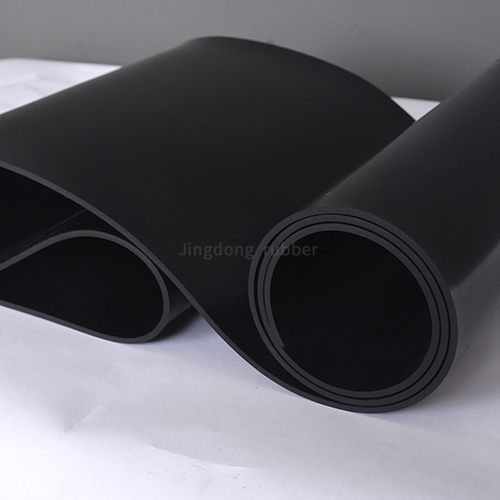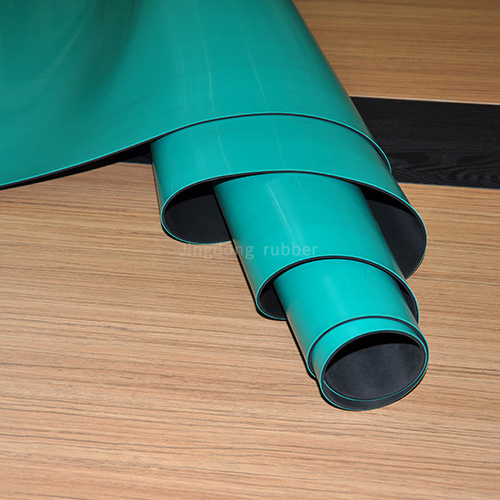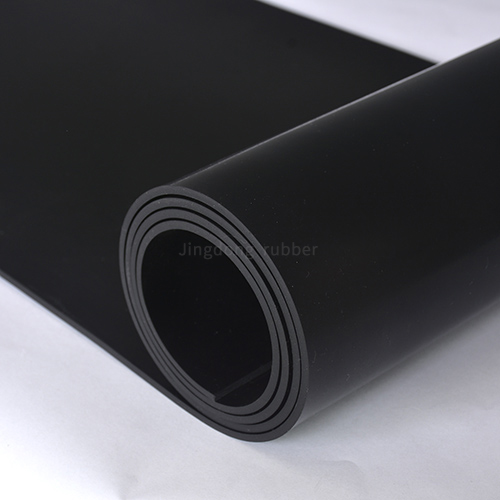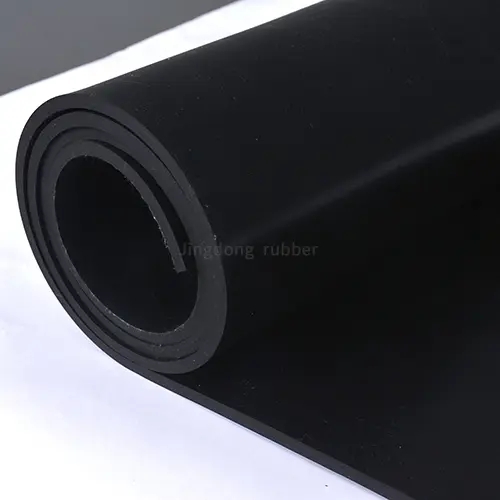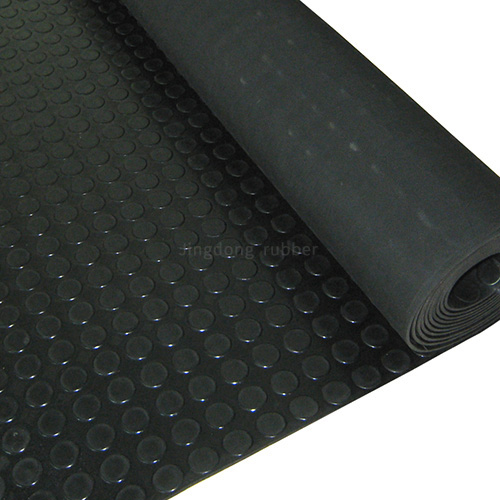

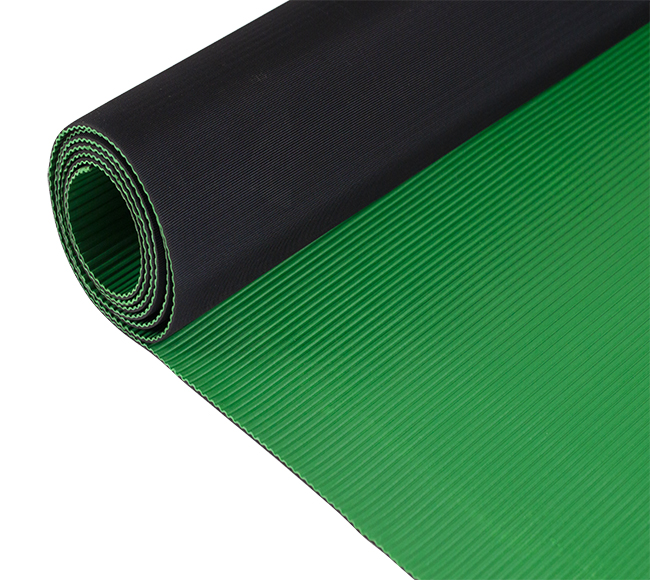
EPDM Rubber Sheet — Weather-Resistant Sheet for Outdoor Sealing, Waterproofing and Gaskets
A synthetic elastomer sheet built on a fully saturated polymer backbone, supplied in five grades from 50 to 65 Shore A. EPDM rubber sheet is chosen where the seal, gasket or lining has to survive ozone, ultraviolet light, water and heat for years without maintenance: its main chain carries no reactive double bonds for ozone or UV to attack, which is why it outperforms natural rubber, SBR and NBR outdoors by a wide margin. It has no resistance to petroleum oils or fuels, so it is the wrong material wherever oil is present.
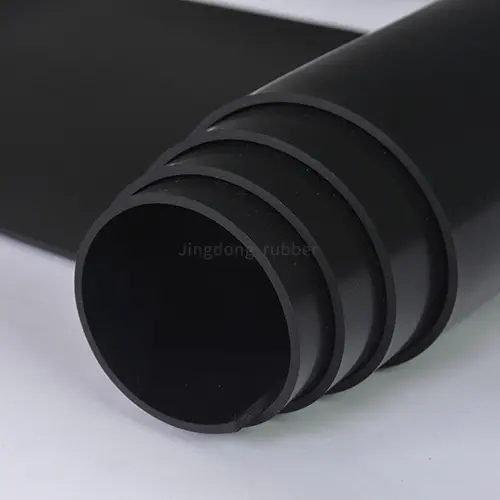

EPDM Rubber Sheet — Ethylene Propylene Diene Monomer Sheet for Outdoor Sealing and Waterproofing
EPDM stands for ethylene propylene diene monomer. It is a terpolymer built from ethylene, propylene and a small percentage of a diene, and that third monomer is present for one reason only: to provide the double bonds that the vulcanising system needs to cross-link the rubber into a network. Everything that makes EPDM rubber sheet valuable as a sealing material follows from where those double bonds are.
In EPDM the double bonds sit on short side groups branching off the main chain; the main chain itself is fully saturated. Ozone and ultraviolet light attack rubber by reacting with double bonds, so a polymer with a saturated backbone has almost nothing for them to attack. This is the technical reason EPDM does not crack in the way natural rubber and SBR do when they are stretched and left in sunlight, and it is why EPDM rubber sheet, EPDM weatherstrip and EPDM roofing membrane all share the same reputation for lasting decades outdoors. The same saturated structure also gives EPDM its heat resistance, which is why it holds up to +120°C where natural rubber is limited to roughly +80°C.
The trade-off is equally clear. A saturated, non-polar hydrocarbon chain has no affinity for petroleum-based oils and fuels, so EPDM swells severely in mineral oil, diesel and petrol and should never be specified for those media. It also burns readily, unlike neoprene rubber sheet, which is inherently flame retardant. Where oil resistance is the requirement, NBR rubber sheet is the correct material; where oil resistance is not needed and the lowest cost is, SBR rubber sheet can sometimes substitute, but SBR has none of the weather resistance.
The five grades below are the same EPDM polymer family at different filler loadings. Filler content sets the balance between cost, density and mechanical strength, so the grade should be selected against the mechanical duty rather than against price alone.
EPDM Rubber Sheet Grades and Physical Properties
Five standard grades are produced. The code itself carries the specification: JD-EPB identifies the material, the next two digits give the nominal hardness in Shore A, and the last three digits give the specific gravity multiplied by 100. So JD-EPB65150 is an EPDM sheet at 65 Shore A and 1.50 g/cm³, and JD-EPB60115 is an EPDM sheet at 60 Shore A and 1.15 g/cm³.
That last figure is worth understanding, because specific gravity is a direct read on filler content. EPDM base polymer is one of the lightest rubbers in common use, so a low compound density means less filler and more polymer. JD-EPB60115 at 1.15 g/cm³ is the clearest example: it is the lightest grade in the range and also the strongest, at 14 MPa tensile strength and 350 % elongation. Where a buyer is comparing quotations from two suppliers, the specific gravity on the data sheet is usually the fastest way to tell a premium compound from a filled one.
Grade table — on a mobile device, scroll sideways to read every column.
| Code | Grade | Hardness Shore A | S.G. g/cm³ | Tensile strength MPa | Elongation at break % | Colour |
|---|---|---|---|---|---|---|
| JD-EPB65150 | Economy | 65 | 1.50 | 3 | 200 | Black |
| JD-EPB50135 | Soft EPDM | 50 | 1.35 | 4 | 250 | Black |
| JD-EPB65145 | Commercial | 65 | 1.45 | 4 | 250 | Black |
| JD-EPB65135 | High grade — 65 Shore A | 65 | 1.35 | 5 | 300 | Black |
| JD-EPB60115 | High grade — 60 Shore A | 60 | 1.15 | 14 | 350 | Black |
Test methods to add: these properties should be reported against ASTM D412 for tensile strength and elongation, ASTM D2240 for durometer hardness and ASTM D792 for specific gravity. Stating the test method is what lets a buyer compare these figures with a competitor’s data sheet on equal terms, and it is the single easiest credibility improvement available on this page. The two grades both named “High grade” are not equivalent — JD-EPB65135 is a 65 Shore A, 5 MPa compound while JD-EPB60115 is a 60 Shore A, 14 MPa compound — so please quote the code rather than the grade name.
Standard Dimensions and Thickness Range
Sheet is supplied in roll form at the thinner end of the range and as flat sheet at the thicker end, because a thick sheet cannot be rolled without setting a curl into it. Width and length are quoted as a standard band rather than a single size, and the exact dimensions of a given order are confirmed at quotation.
Dimensions — on a mobile device, scroll sideways to read every column.
| Property | Range | Supply form |
|---|---|---|
| Width | 0.915 m up to 1.5 m | Roll or sheet |
| Length | 10 m to 20 m | Roll or sheet |
| Thickness | 1 mm to 20 mm | In roll |
| Thickness | 20 mm to 50 mm | In sheet |
| Thickness | 50 mm to 100 mm | Confirm supply form and lead time |
| Cut sizes | To drawing | Cut or slit to order |
Thickness range to confirm: the specification states a standard thickness range up to 100 mm, but the supply form is described only up to 50 mm (1–20 mm in roll, 20–50 mm in sheet). The row above for 50–100 mm therefore needs the actual supply form and lead time filled in. If 100 mm is only achievable in specific grades or to special order, saying so is better than leaving the range open.
Chemical and Environmental Resistance
Chemical resistance is the first thing a sealing engineer checks and usually the last thing a rubber sheet page states, which is why so many enquiries begin with a compatibility question. The two columns below set out where EPDM rubber sheet is a safe choice and where it is not.
EPDM performs well with
- Ozone, ultraviolet light and weathering — the defining strength of the material and the reason it is used for roofing membrane, weatherstrip and any seal left outdoors.
- Water, hot water and steam — excellent resistance, which is why EPDM is used for pipe seals, radiator and heater hose, and potable water applications in an appropriate grade.
- Continuous heat up to +120°C — a far wider range than natural rubber or SBR, and the reason EPDM is chosen for engine-compartment and hot-water duties.
- Dilute acids and alkalis — good resistance across the common range, subject to concentration and temperature.
- Alcohols, glycols and glycol-based brake fluid — EPDM is the standard seal material for glycol brake systems, and also suits phosphate-ester hydraulic fluids.
- Silicone oils and greases — good resistance, which makes EPDM a common choice where silicone lubricants are present.
EPDM is not suitable for
- Petroleum oils, greases and fuels — mineral oil, diesel and petrol cause severe swelling. This is the single most common mistake made with EPDM and it is not a matter of degree. Use NBR rubber sheet instead.
- Aromatic hydrocarbons — benzene, toluene and xylene swell EPDM severely.
- Ketones — acetone and methyl ethyl ketone are rated poor to unsuitable for EPDM in the standard seal compatibility references. Confirm any ketone duty by test rather than from a general table.
- Chlorinated solvents — not suitable without a compatibility test.
- Flame exposure — EPDM burns readily and is not flame retardant. Where flame resistance is required, neoprene rubber sheet is the correct choice.
- Concentrated oxidising acids — resistance falls off sharply with concentration and temperature, so these require testing rather than assumption.
Correction required on the existing page: the current description states that EPDM has “good resistance to alkalines, diluted acids and ketones”. Ketones should not appear in that list. Acetone and methyl ethyl ketone are rated poor to unsuitable for EPDM in the standard compatibility references, and the neoprene page on this same site correctly states that CR is not suitable for ketones. As written, the two pages together imply that ketones are covered by EPDM, which would lead a buyer into a seal failure. The list above has been corrected, and the missing oil and fuel limitation — which the original page did not mention at all — has been added.
EPDM, Neoprene (CR) and NBR Compared
Most rubber sheet enquiries come down to a choice between three materials. The table below sets out where each one wins, because selecting the wrong base polymer is a far more expensive error than selecting the wrong grade within the right polymer.
Material comparison — on a mobile device, scroll sideways to read every row.
| Property | EPDM | Neoprene (CR) | NBR |
|---|---|---|---|
| Ozone and weathering | Excellent | Very good | Poor |
| Ultraviolet and sunlight | Excellent | Very good | Poor |
| Service temperature | −40 to +120°C | −30 to +70°C stated | −30 to +100°C |
| Water and steam | Excellent | Good | Good |
| Petroleum oils, greases and fuels | Not suitable | Moderate | Excellent |
| Aromatic hydrocarbons and ketones | Not suitable | Not suitable | Moderate |
| Dilute acids and alkalis | Good | Good | Fair |
| Glycol brake fluid and phosphate esters | Good | Fair | Poor |
| Flame resistance | Burns readily | Inherently retardant | Burns readily |
| Typical outdoor duties | Roofing, pond liners, weatherstrip, pipe seals | Marine linings, dock fenders, expansion joints | Not for outdoor use |
The decision usually reduces to two questions. First, will the sheet contact petroleum oil or fuel? If yes, NBR is the only one of the three that works and the choice is made. Second, if not, does the duty need oil resistance at all? If it does not, EPDM is normally cheaper, has a wider temperature range and resists weather better than CR. Only where a combination of moderate oil resistance and outdoor exposure is required does neoprene become the correct answer. The full range is listed under the industrial rubber sheet category.
Applications
EPDM rubber sheet is specified wherever weather, water or heat is the dominant requirement and oil is absent. The common duties are set out below.
Applications — on a mobile device, scroll sideways to read every column.
| Application | Why EPDM is selected |
|---|---|
| Pipe seals and flange gaskets | Water, hot water and steam resistance together with a wide temperature range. The classic use for EPDM sheet in water and drainage systems. |
| Weather strips and window seals | The dominant automotive and building weatherstrip material, because it does not harden or crack under years of UV and ozone exposure. |
| Roofing membrane | EPDM is the leading single-ply roofing membrane material. Large sheets are joined on site and the seam is bonded, which requires the sheet to hold its properties for decades without maintenance access. |
| Pond, reservoir and tank liners | Continuous water contact with no oil present. The material is inert to water and does not leach, and it tolerates ground movement without cracking. |
| Automotive cooling and brake systems | Radiator and heater hose, and seals for glycol-based brake fluid, where EPDM is the standard material because it resists both hot water and glycol. |
| Electrical insulation and cable jackets | Good dielectric properties combined with weather resistance for outdoor cable and insulating pads. |
| Sleeves and protective covers | Flexible sleeves exposed to weather, where the material has to stay flexible through repeated movement over a long service life. |
| Potable water and food contact | Where an appropriate grade is specified, covered separately under FDA rubber sheets. |
Selecting and Installing EPDM Rubber Sheet
Selection follows a fixed order, because each decision constrains the next. Working through the sequence below avoids the two common mistakes: choosing EPDM for a duty that contains oil, and choosing a grade on price and then finding it will not hold a seal.
- Confirm there is no petroleum oil, fuel or aromatic solvent in the duty This check comes first because it is a hard fail rather than a matter of degree. EPDM swells severely in mineral oil, diesel, petrol and aromatic hydrocarbons, and no grade within the EPDM family will fix that. If oil is present, NBR rubber sheet is the correct material and the rest of this sequence does not apply.
- Check the temperature against the −40°C to +120°C range EPDM handles a far wider range than natural rubber or SBR. Note that the upper limit is a continuous-service figure: intermittent excursions above it are tolerated, but the sheet will harden progressively if the continuous limit is exceeded, and the seal will eventually stop conforming to the flange.
- Choose the hardness against the joint Hardness determines how well the sheet conforms to the mating surfaces. The 50 Shore A JD-EPB50135 softens into a rough or slightly uneven flange at low bolt load, while a 65 Shore A grade resists compression set better under sustained load. Where the flange is flat and the bolt load is high, the harder grade gives a more stable seal over time.
- Choose the grade against the mechanical duty Tensile strength and elongation run from 3 MPa and 200 % in the economy grade to 14 MPa and 350 % in JD-EPB60115. For a static gasket under modest load the economy grade is often adequate. For a lining or sleeve subject to abrasion, flexing or repeated handling, the low-density high-tensile grades last considerably longer, and the difference in unit price is normally much smaller than the difference in service life.
- Fix the thickness against the flange and the gap Gasket thickness has to fill the gap the flange presents without crushing the sheet beyond its elastic range. Too thin and the sheet cannot accommodate surface irregularity; too thick and it extrudes or takes a permanent set. Thickness runs from 1 mm to 100 mm, with 1–20 mm supplied in roll and 20–50 mm in sheet form.
- Cut, bond and install EPDM cuts cleanly with a die, knife or water jet, and bonds to itself and to metal using an EPDM-rated contact adhesive — an adhesive selected for neoprene will not give the same bond. Tighten flange bolts progressively in a crossing pattern rather than fully tightening one bolt at a time, so the sheet compresses evenly. Store unused sheet flat, out of sunlight and away from electric motors, because ozone is the specific hazard for a stretched rubber sheet.
Buyer FAQ
- What does EPDM stand for and what is EPDM rubber sheet?EPDM stands for ethylene propylene diene monomer. It is a synthetic elastomer in which the main polymer chain is fully saturated, with the double bonds needed for vulcanisation carried on short side groups instead. That structure is why EPDM resists ozone, ultraviolet light and ageing so well. The sheet is supplied in five grades from 50 to 65 Shore A.
- What is the temperature range of EPDM rubber sheet?The stated service range is −40°C to +120°C, which is considerably wider than natural rubber or SBR. The upper figure is a continuous-service limit; sustained operation above it will harden the sheet progressively and the seal will eventually stop conforming to the flange.
- Can EPDM rubber sheet be used with oil, fuel or solvents?No. EPDM has no resistance to petroleum oils, greases, diesel or petrol, and it swells severely in aromatic hydrocarbons such as benzene and toluene. It is also rated poor to unsuitable for ketones such as acetone and methyl ethyl ketone. Where any of those media are present, NBR rubber sheet is the correct material and no grade of EPDM will substitute.
- What is the difference between EPDM and neoprene rubber sheet?EPDM has the better weather resistance and a much wider temperature range, and it is normally cheaper. Neoprene has moderate resistance to animal and vegetable oils and is inherently flame retardant, which EPDM is not. Where the duty involves a combination of outdoor exposure and light oil contact, neoprene is the better answer; where it is weather, water or heat alone, EPDM is.
- Which grade should I choose?Confirm first that no oil or fuel is present, then choose hardness against the joint and grade against the mechanical duty. For a lightly loaded static gasket the economy grade is often adequate; for a lining or sleeve subject to abrasion or flexing, JD-EPB60115 at 14 MPa tensile strength and 1.15 g/cm³ lasts considerably longer. The two grades both named High grade are not equivalent, so please quote the code.
- Can the sheet be cut to size and what sizes are available?Standard width runs from 0.915 m to 1.5 m and standard length from 10 m to 20 m, with thickness from 1 mm to 100 mm. Sheet is cut or slit to a drawing. Send the finished part dimensions, the thickness, the grade code if known, and the quantity for a quotation.
Related Rubber Sheet Materials
Send the Medium, Temperature and Size for a Quotation
Tell us what the sheet will contact and at what temperature, the hardness or grade code you need, the thickness and the finished size, and the quantity required. If you are replacing an existing gasket, send the original thickness and hardness and we will match the grade and reply with price and lead time.
Request a Quotation